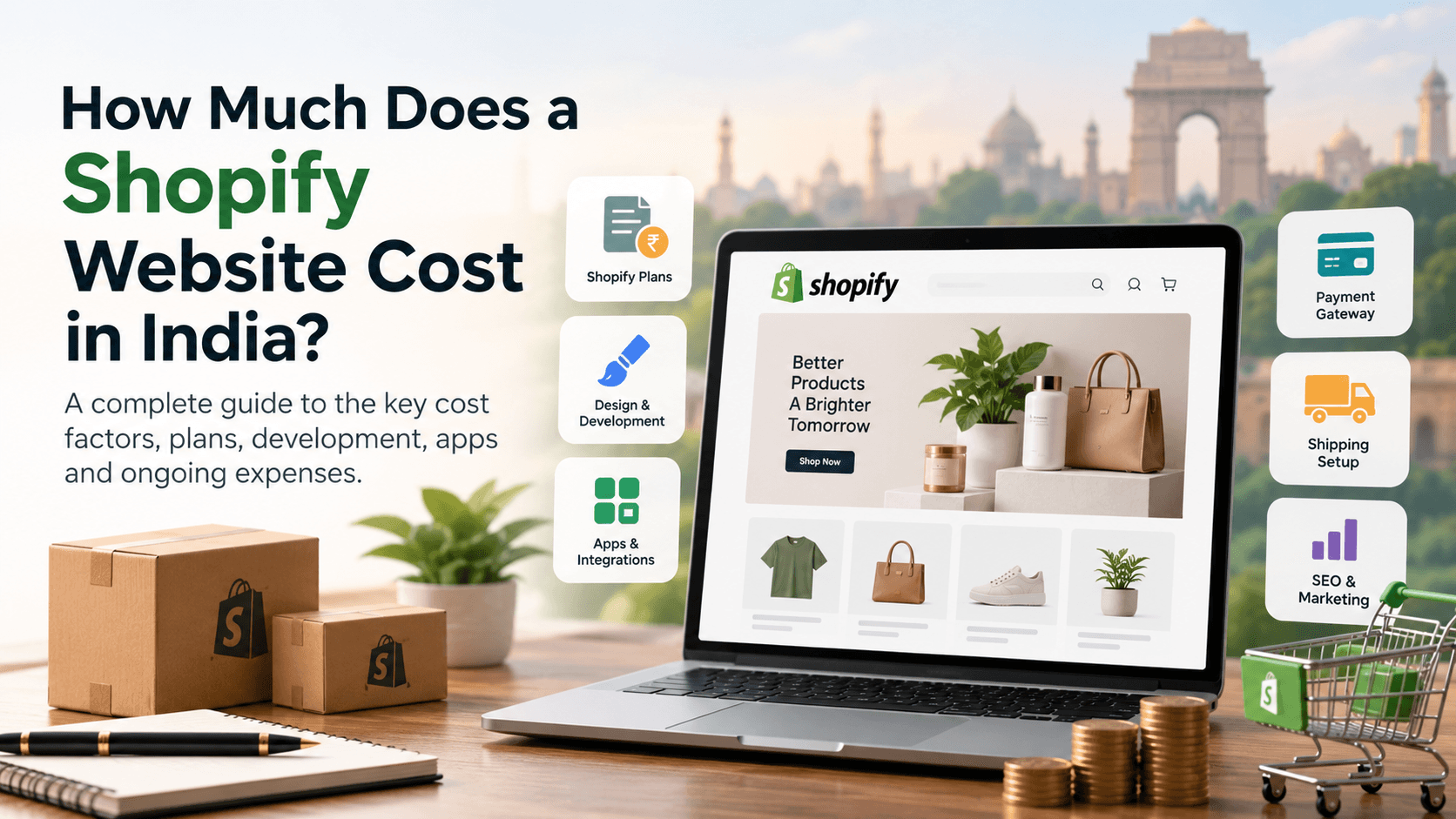

If you are planning to launch an online store, one of the first questions you may ask is: how much does a Shopify website cost in India? The answer is not a single fixed number because the total investment depends on your Shopify plan, design requirements, number of products, apps, payment setup, shipping integrations, SEO needs, custom functionality and ongoing store management.
Shopify provides the ecommerce platform, hosting, checkout infrastructure and core store-management tools. However, the final cost of building and running a Shopify website depends on what your business actually needs.
A small business using a standard theme and basic functionality will have a very different setup from a growing D2C brand that needs advanced filtering, custom product pages, subscriptions, ERP connections, marketing automation and technical SEO.
This guide explains the major cost components involved in building a Shopify store in India without giving a fixed development price, because Shopify development cost should always be based on project scope.
What Determines the Cost of a Shopify Website in India?
The total cost of a Shopify website generally includes several separate elements rather than one single charge.
Your budget may include:
- Shopify subscription plan
- Domain name
- Store design and development
- Free, premium or customized theme
- Shopify apps
- Payment gateway charges
- Shipping and courier integrations
- Product catalogue setup
- SEO configuration
- Analytics and tracking
- Custom functionality
- Third-party integrations
- Content and product photography
- Ongoing maintenance and optimization
- Digital marketing
The important point is that the Shopify subscription is only one part of the overall ecommerce investment.
Before deciding your budget, first define what the store needs to achieve for your business.
Shopify Plans Available for Indian Businesses
Shopify offers multiple plans for businesses with different operational requirements. Instead of choosing a plan only because it is the lowest-priced option, consider your team size, order volume, reporting requirements, international selling needs and required features.
The commonly available Shopify plans include Basic, Grow, Advanced and Shopify Plus.
Basic
The Basic plan is generally suitable for new ecommerce businesses, startups, smaller product catalogues and businesses that need the essential tools required to launch an online store.
It can be a practical starting point for brands that need product management, checkout, inventory management and a professional storefront without more advanced operational requirements.
Grow
The Grow plan is suitable for businesses that are beginning to scale and may require more staff access, stronger operational capabilities and additional features.
It can be relevant for growing ecommerce brands that are processing more orders and have multiple people managing the store.
Advanced
The Advanced plan is intended for larger or more complex ecommerce businesses that need advanced reporting, shipping capabilities and broader operational features.
It may be appropriate for brands with higher order volumes, larger teams, multiple markets or more complex fulfilment requirements.
Shopify Plus
Shopify Plus is Shopify’s enterprise-level offering.
It is designed for larger brands that require higher levels of customization, automation, scale, integrations and enterprise ecommerce functionality.
The right plan should be selected according to business requirements rather than only monthly subscription cost.
Is the Shopify Subscription the Total Website Cost?
No. The Shopify subscription covers the ecommerce platform, but it does not automatically include everything required to create a complete, conversion-focused online store.
You may still need store design, product setup, theme customization, payment configuration, shipping setup, custom sections, app integrations, product content, SEO, analytics, conversion tracking, custom development and ongoing optimization.
This is why asking only about the monthly Shopify plan does not give a complete picture of the investment.
A more useful question is: What functionality, design, integrations and marketing foundation does my Shopify store need to support my business goals?
Shopify Website Development Cost in India
Shopify website development cost in India depends on the scope of the project.
A developer or ecommerce agency should first understand your products, customer journey, required integrations, branding, shipping model and marketing strategy before estimating the development effort.
There is no meaningful single price that applies to every Shopify website.
Basic Shopify Store Setup
A relatively simple Shopify store may include theme installation, brand colours and typography, homepage setup, product upload, collection setup, menu and navigation, standard product pages, basic payment configuration, shipping setup, policy pages, contact page, mobile optimization and basic SEO configuration.
This type of store is generally suitable for businesses that need standard ecommerce functionality and want to launch without extensive custom development.
Custom Shopify Website
A more advanced Shopify store may require custom UI and UX design, custom homepage sections, custom collection pages, advanced product layouts, mega menu, product filters, wishlist, product bundles, subscriptions, upselling, cross-selling, advanced search, custom cart functionality, COD workflows, WhatsApp integration, advanced shipping rules, custom forms, marketing automation, analytics setup, conversion tracking, third-party integrations, technical SEO and custom Shopify development.
The more unique functionality a business requires, the greater the development effort involved.
What Factors Affect Shopify Website Development Cost?
1. Number of Products
The number of products can significantly affect setup time.
A small catalogue may be straightforward, while a large catalogue may require extensive work involving product data, variants, images, SKUs, pricing, product specifications, collections, tags, metafields, SEO titles, meta descriptions and alt text.
If product information is not organized before development begins, the project may also require additional catalogue cleanup.
2. Number of Collections and Categories
Good ecommerce navigation depends on a clear category structure.
A store with multiple product types may require main collections, sub-collections, filters, tags, menu hierarchy, landing pages and collection descriptions.
Planning this structure correctly is important for both user experience and SEO.
3. Theme Selection
Shopify stores can use free themes, premium themes or customized themes.
A free theme may be enough for businesses with simple requirements.
A premium theme can provide additional layouts or functionality, but it may still require customization to match your brand.
A custom Shopify experience requires more design and development work because the store is built around specific brand and customer requirements.
4. UI and UX Customization
Design complexity is another major factor.
Customization may include a custom homepage, unique banners, product-card design, custom product-page layout, mobile-specific sections, sticky Add to Cart, custom navigation, promotional sections, comparison tables, FAQ sections, reviews and trust elements.
A professional ecommerce design should focus on usability and conversion, not only visual appearance.
5. Shopify Apps
Apps are often used to extend Shopify functionality.
Common app categories include reviews, wishlist, loyalty programs, product options, subscriptions, booking, bundles, upselling, WhatsApp, email marketing, shipping, COD verification, product filters, search, SEO and analytics.
Some apps are free while others use recurring or usage-based pricing.
Businesses should avoid installing unnecessary apps because too many apps can increase recurring costs and may affect website performance.
6. Payment Gateway Integration
Indian ecommerce customers may expect payment options such as UPI, credit cards, debit cards, net banking, wallets and Cash on Delivery.
The exact payment setup depends on the gateway, business eligibility and customer requirements.
Payment providers may charge their own processing fees, and other platform-related charges may apply depending on the Shopify setup.
These payment costs should be considered as operational expenses rather than website development charges.
7. Cash on Delivery Setup
COD remains relevant for many Indian ecommerce businesses, but it requires careful planning.
A COD workflow may include COD availability rules, PIN-code validation, OTP verification, WhatsApp confirmation, phone verification, COD charges, partial payment, order-risk checks and RTO management.
The right setup depends on product value, customer type and fulfilment strategy.
8. Shipping and Courier Integration
Shipping setup can range from simple to highly complex.
Businesses may need shipping aggregator integration, courier integration, weight-based shipping, zone-based shipping, free-shipping conditions, PIN-code serviceability, local delivery, order tracking, shipping notifications, return workflows and RTO management.
Stores with different product weights, delivery zones or special shipping conditions require more planning.
9. Product Content
Product content is an important part of ecommerce development.
Strong product pages may include product title, product description, benefits, features, specifications, ingredients or materials, usage instructions, size information, FAQs, delivery information, product images, videos and reviews.
Better product content supports customer confidence, search visibility and conversion.
10. Shopify SEO
SEO should be considered before the store goes live.
A Shopify SEO setup may include keyword research, product SEO, collection-page SEO, meta titles, meta descriptions, image alt text, internal linking, URL review, canonical review, schema markup, breadcrumbs, technical SEO, blog strategy and Search Console setup.
SEO is especially important for brands that want to build organic traffic instead of depending entirely on paid advertising.
11. Analytics and Conversion Tracking
Tracking should be implemented before marketing campaigns begin.
Depending on the business, this may include Google Analytics, Google Search Console, Google Ads tracking, Meta Pixel, Google Merchant Center and ecommerce event tracking.
Important ecommerce events may include product view, add to cart, begin checkout, purchase, form submission and WhatsApp click.
Without accurate tracking, it is difficult to understand which marketing activities are generating revenue.
Ongoing Costs of Running a Shopify Store
The cost of a Shopify website does not end after launch.
Ongoing expenses may include the Shopify subscription, domain renewal, paid apps, payment processing, shipping, marketing, SEO, design updates, development support, content, product photography and conversion optimization.
The exact ongoing cost depends on how actively the business operates and markets the store.
Do Shopify Websites Need Maintenance?
Shopify manages hosting and much of the core platform infrastructure, but the store still needs regular management.
Ongoing work can include adding products, updating banners, changing promotions, updating apps, reviewing performance, improving SEO, creating landing pages, checking analytics, testing checkout, fixing integration issues and improving conversion rates.
An ecommerce website should be treated as an active sales channel rather than a one-time development project.
How Can Businesses Control Shopify Website Costs?
The best way to control cost is to define priorities before development begins.
Start With Essential Features
Focus first on mobile-first design, clear product pages, easy navigation, reliable payments, shipping setup, trust signals, SEO basics, analytics and conversion-focused checkout.
Advanced features can be introduced when there is a genuine business need.
Avoid Unnecessary Apps
Installing multiple apps with overlapping functionality can increase monthly expenses and affect performance.
Review whether an app solves a real problem before adding it.
Organize Product Data Early
Prepare your product names, prices, SKUs, images, descriptions, categories and variants before development begins.
Well-organized product data can make the implementation process much smoother.
Choose the Right Shopify Plan
Do not automatically choose the highest plan.
Select the plan that fits your current requirements and review it as the business grows.
Plan SEO From the Beginning
Building the site first and fixing SEO later can create unnecessary additional work.
Plan URLs, collections, content hierarchy, metadata and internal linking during development.
Is Shopify Worth It for Indian Businesses?
Shopify can be a strong option for Indian businesses that want a managed ecommerce platform with built-in store, product, inventory, checkout and order-management capabilities.
It can be suitable for D2C brands, FMCG businesses, fashion brands, beauty businesses, home and lifestyle brands, manufacturers, retailers, startups and established ecommerce businesses.
However, the right ecommerce platform depends on your requirements.
Before choosing Shopify, consider your product catalogue, required features, internal team, payment needs, shipping needs, customization, marketing plan, scalability, international expansion and long-term operating requirements.
Shopify vs WooCommerce: Which Is More Cost-Effective?
There is no universal answer.
Shopify is a hosted ecommerce platform with a recurring plan, while WooCommerce runs on WordPress and requires separate decisions around hosting, plugins, security and maintenance.
Shopify may be suitable for businesses that prefer a managed ecommerce ecosystem.
WooCommerce may suit businesses that want greater WordPress flexibility and control.
Instead of comparing only starting costs, compare features, maintenance, apps or plugins, hosting, development, scalability, security, integrations and long-term management.
The best platform is the one that fits your business model and operational needs.
Frequently Asked Questions About Shopify Website Cost in India
How much does a Shopify website cost in India?
There is no single fixed Shopify website cost. The total depends on the Shopify plan, domain, theme, product catalogue, design requirements, apps, payment setup, shipping, SEO, integrations and ongoing management.
How much does Shopify development cost in India?
Shopify development cost varies by project scope. A standard theme-based store requires different work from a customized D2C website with advanced functionality and third-party integrations. A project-specific quotation is more accurate than a generic development price.
Which Shopify plan should a small business choose?
A smaller business may begin with a plan that provides the core ecommerce features it needs and move to another plan as its team, sales and operational requirements grow.
Do I need a developer for Shopify?
Not always. Shopify allows businesses to create stores using themes and built-in tools. A developer becomes useful when you need custom design, advanced functionality, integrations, migration, technical SEO or specialized workflows.
Is hosting included with Shopify?
Shopify is a hosted ecommerce platform, so businesses do not generally need to purchase traditional web hosting separately for their Shopify storefront.
Do I need a domain for Shopify?
A custom domain is recommended for a professional ecommerce brand. Domain registration and renewal should be considered separately when planning your store.
Are Shopify apps necessary?
Not every store needs many apps. Apps should be selected according to actual requirements such as reviews, subscriptions, advanced product options, shipping, WhatsApp or marketing automation.
Can Shopify support UPI and COD?
Indian Shopify stores can configure relevant payment methods based on supported payment providers and business requirements. COD can also be configured where appropriate.
Does Shopify support SEO?
Shopify provides several SEO-friendly features, but a complete SEO strategy still requires keyword research, content optimization, internal linking, product and collection optimization, technical review and ongoing work.
Can Shopify handle a large product catalogue?
Yes, Shopify can support large catalogues, but catalogue structure, collections, filters, search, product data and integrations should be planned carefully for a good customer experience.
Is Shopify suitable for D2C brands in India?
Shopify can be suitable for D2C brands that want control over branding, product presentation, direct customer journeys, marketing integrations and ecommerce operations.
Looking for Shopify Website Development in Pune or Across India?
The cost of a Shopify website should be evaluated according to what the store needs to achieve, not only the platform subscription.
A successful ecommerce store needs the right combination of store architecture, design, product experience, payments, shipping, mobile usability, SEO, analytics, conversion optimization and marketing.
Start Above LLP provides Shopify website development services for businesses in Pune and across India.
Our Shopify services can include Shopify website development, Shopify store redesign, theme customization, custom Shopify sections, product and collection setup, marketplace-to-Shopify migration, WooCommerce-to-Shopify migration, payment gateway configuration, shipping integration, COD setup, WhatsApp integration, Shopify SEO, analytics and tracking, conversion optimization and performance marketing.
Get a Shopify Website Cost Estimate Based on Your Requirements
Instead of choosing a generic package or relying on a fixed development price, start with your actual business requirements.
Your product catalogue, design expectations, customer journey, payment methods, shipping rules, app requirements, SEO goals and integrations should determine the project scope.
Start Above LLP
Call: +91 90283 17379
Website: startabove.in
Contact Start Above LLP to discuss your Shopify website requirements and receive a project-specific quotation.