
Why Website Traffic Is Increasing but Leads Are Not
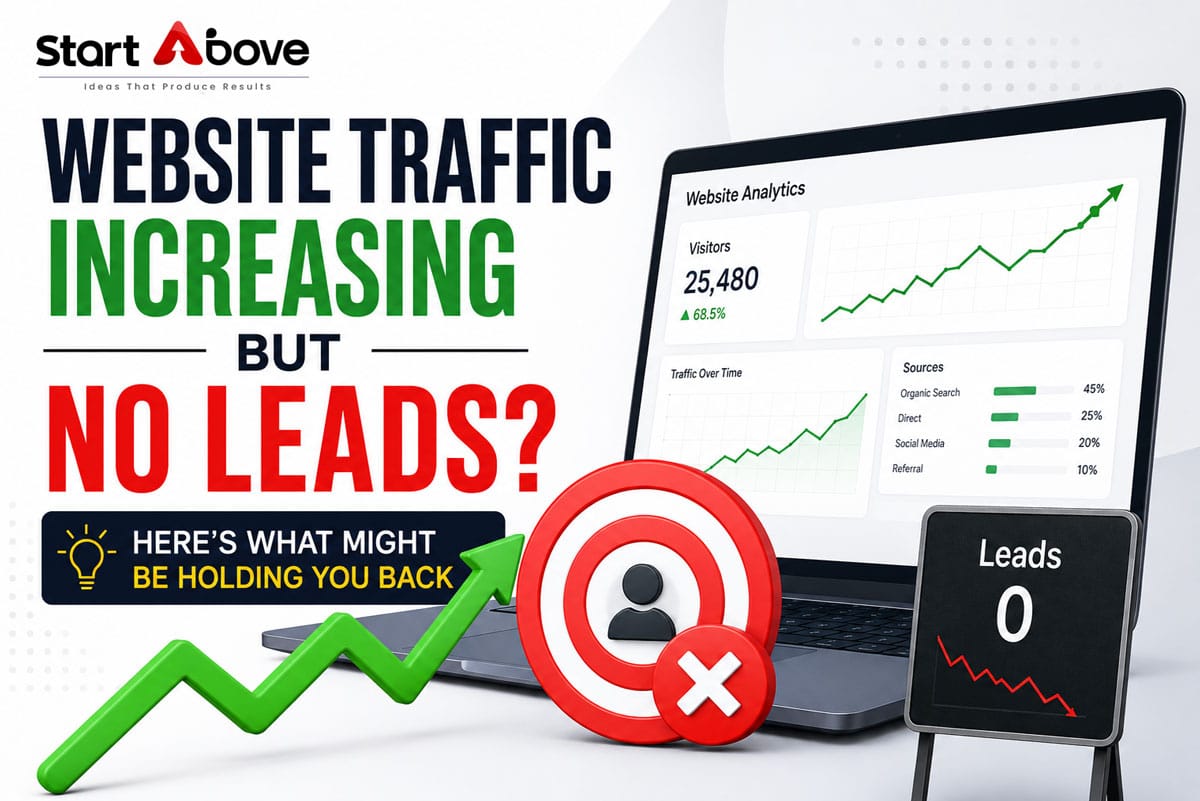
If your business is experiencing website traffic but no leads, you are not alone. Many companies invest in SEO, social media, Google Ads, and content marketing, only to discover that increasing visitor numbers do not automatically translate into enquiries, calls, or sales. When website traffic is not converting, the issue usually lies in attracting the wrong audience, unclear messaging, weak calls to action, poor user experience, or ineffective lead tracking.
The encouraging part is that most of these issues can be identified and improved. This guide explains why your website may attract visitors without generating sufficient leads and what you can do to turn relevant traffic into genuine business opportunities.
What Does Website Traffic but No Leads Actually Mean?
Website traffic refers to people who visit your website through channels such as:
- Google Search.
- Google Ads.
- Instagram and Facebook.
- Email campaigns.
- Business directories.
- Google Business Profile.
- Referral links from other websites.
A lead is someone who takes a meaningful step toward becoming a customer, such as:
- Completing an enquiry form.
- Calling your business.
- Requesting a quotation.
- Booking a consultation.
- Sending a WhatsApp message.
- Scheduling a product demonstration.
- Visiting a contact page and submitting their details.
When visits increase but enquiries remain flat, your website may have a traffic-quality issue, a conversion issue, a tracking issue, or a combination of all three. For example, a Pune-based interior design company might receive thousands of visitors through an article about general living room inspiration. However, if those visitors are outside its service area or are not ready to hire an interior designer, the extra traffic may produce few enquiries.
This is why website performance should be evaluated using qualified leads and conversion rates, not traffic numbers alone.
1. You Are Attracting the Wrong Website Traffic
One of the most common reasons for high website traffic and low conversions is that the website attracts visitors who are unlikely to become customers. This can happen when your content ranks for broad informational terms but does not reach people who need your actual services.
For example:
- A dental clinic ranks for “home remedies for toothache” but not “dentist in Kothrud.”
- A manufacturer ranks for “what is industrial steel” but not “industrial shed manufacturer in Pune.”
- A digital marketing agency ranks for “free Instagram caption ideas” but not “social media marketing services in Pune.”
The first type of keyword may increase visibility, but it does not always attract someone looking to hire a service provider.
How to Fix Website Traffic but No Leads Caused by Poor Targeting
Build a balanced keyword strategy that includes:
- Informational keywords that educate potential customers.
- Commercial keywords that help people compare solutions.
- Service-related keywords that indicate purchase intent.
- Location-based keywords that attract relevant local customers.
For example, a digital marketing agency might target:
- “Why website traffic is not converting.”
- “How to improve website conversion rate.”
- “Website lead generation services.”
- “Digital marketing agency in Pune.”
Each keyword serves a different stage of the customer journey. Connecting these stages through relevant internal links and calls to action makes it easier to turn useful traffic into enquiries.
2. Your Website Does Not Explain What You Offer Clearly
Visitors should quickly understand:
- What your business does.
- Who your services are for.
- Which problem you solve.
- Why someone should choose you.
- What action they should take next.
If your homepage begins with vague statements such as “Transforming possibilities into excellence,” visitors may struggle to understand your actual services.
A clearer alternative would be:
“Digital marketing services for Pune businesses that want more visibility, qualified enquiries, and measurable growth.”
This communicates the service, the audience, and the intended outcome.
Improve Website Conversion Rates With Clear Messaging
Review the first section of your homepage and service pages.
Make sure it includes:
- A straightforward headline.
- A short explanation of your services.
- A relevant benefit for the customer.
- A visible call to action.
- Supporting information that builds trust.
A website that communicates clearly helps visitors decide whether they are in the right place.
3. Your Calls to Action Are Missing or Too Generic
A call to action tells visitors what they should do next. If your pages end without direction, potential customers may leave even when they are interested.
Generic buttons such as “Submit” or “Click Here” also provide little motivation.
More useful calls to action include:
- “Request a Free Website Review.”
- “Book a Digital Marketing Consultation.”
- “Get a Quote for Your Project.”
- “Speak With Our SEO Team.”
- “Check Your Website’s Lead Generation Potential.”
- “Discuss Your Business Goals.”
The right CTA depends on the page and the visitor’s likely intent.
For example, someone reading a blog post may respond better to a website review than an immediate “Buy Now” message.
Place Website Lead Generation CTAs Where Visitors Notice Them
Consider adding relevant calls to action:
- Near the top of important service pages.
- After sections that explain a major customer problem.
- Next to testimonials or case studies.
- At the end of useful blog articles.
- On mobile through an easy-to-access contact or WhatsApp button.
Avoid placing so many CTAs that the page feels distracting or aggressive.
4. Your Contact Forms Ask for Too Much Information
Long forms can discourage people from enquiring, especially when they are still comparing service providers.
For an initial business enquiry, you often need only:
- Name.
- Phone number or email address.
- Brief information about the requirement.
By comparison, a form asking for company size, annual revenue, detailed project specifications, preferred meeting dates, and multiple mandatory fields may create unnecessary friction.
This does not mean every business should use the shortest possible form. Some B2B companies need additional details to qualify leads effectively. The goal is to request information that is genuinely useful at that stage.
Reduce Friction to Increase Website Leads
To improve your contact forms:
- Remove unnecessary mandatory fields.
- Make forms easy to complete on mobile devices.
- Explain what happens after submission.
- Include a clear confirmation message.
- Test whether enquiries are reaching the correct inbox or CRM.
- Offer alternative contact options, such as phone or WhatsApp.
A shorter, clearer enquiry process can make it easier for interested visitors to act.
5. Your Website Is Slow or Difficult to Use on Mobile
A website may attract significant traffic and still struggle to generate leads if visitors find the experience frustrating.
Common problems include:
- Pages that load slowly.
- Images that take too long to appear.
- Buttons that are difficult to tap.
- Forms that do not work properly on smaller screens.
- Pop-ups that block important content.
- Text that is difficult to read without zooming.
- Menus that are confusing or unresponsive.
For many local businesses, customers first discover the website on their phones. If calling the business, viewing services, or completing a form feels difficult, potential leads may leave.
Website Conversion Optimization for Mobile Users
Review your website on multiple screen sizes and check whether:
- Phone numbers are clickable.
- WhatsApp buttons open correctly.
- Contact forms are easy to complete.
- Important pages load reliably.
- Navigation is simple and visible.
- CTAs are not hidden below excessive content.
A mobile-friendly experience supports both usability and lead generation.
6. Your Landing Pages Do Not Match Visitor Intent
If someone clicks an ad or search result expecting a specific service, the landing page should address that exact need.
For example, if a user clicks an ad for:
“Google Business Profile Optimization in Pune”
and lands on a general homepage covering branding, web development, social media, and video production, they may struggle to find the information they expected.
A dedicated landing page can provide:
- A clear explanation of the relevant service.
- Common business problems the service addresses.
- Practical benefits.
- Relevant examples or case studies.
- Location details, where applicable.
- A focused call to action.
Landing Page Optimization for Better Website Lead Generation
Create dedicated pages for priority services rather than directing every visitor to your homepage.
For a marketing agency, useful pages may include:
- SEO services.
- Google Business Profile optimization.
- Social media marketing.
- Google Ads management.
- Website development.
- E-commerce website development.
Each page should answer the specific questions a prospective customer is likely to have.
7. Your Website Does Not Build Enough Trust
Visitors may be interested in your services but hesitate to enquire if your business appears unfamiliar or unverified.
Common trust barriers include:
- No client testimonials.
- No business address or contact information.
- No clear explanation of who runs the company.
- Outdated website content.
- Incomplete service pages.
- Generic stock images with no real project examples.
- Claims that sound impressive but lack supporting evidence.
- Missing privacy information or unclear handling of customer data.
Trust matters especially for healthcare, financial services, manufacturing, property, and professional services.
Build Trust to Improve Website Conversion Rates
Useful trust signals include:
- Genuine customer reviews.
- Specific case studies.
- Examples of completed projects.
- Team profiles.
- Clear contact details.
- Relevant certifications or credentials.
- Accurate service information.
- Realistic explanations of timelines and outcomes.
For example, a statement such as:
“We help businesses improve website usability, search visibility, and enquiry generation through coordinated digital marketing.”
is generally more credible than:
“We guarantee the number-one ranking and unlimited leads.”
Avoid exaggerated claims that could make visitors doubt your reliability.
8. Your Content Answers Questions but Does Not Guide the Next Step
Informational content can attract valuable organic traffic. However, blog posts may fail to generate leads when they do not connect the reader’s problem to a relevant next step.
For example, a blog about:
“Why Your Website Is Not Generating Leads”
should naturally lead readers toward:
- A website audit.
- A conversion review.
- A relevant service page.
- A consultation.
- An example of a comparable client project.
Without these connections, visitors may read the article, find the answer, and leave.
Turn Blog Traffic Into Website Enquiries
To make content more useful for lead generation:
- Add relevant internal links to service pages.
- Include practical examples from your industry.
- Explain how a business can diagnose the issue.
- Offer a helpful next step related to the topic.
- Place a relevant CTA near the end of the article.
The goal is not to force a sales pitch into every paragraph. It is to make the next logical action easy to find.
9. Your Website Navigation Makes Important Information Hard to Find
Even interested visitors may leave if they cannot quickly find the right service, pricing information, portfolio, or contact page.
Common navigation problems include:
- Too many menu items.
- Unclear service names.
- Important pages hidden inside multiple dropdown menus.
- No visible contact option.
- Broken internal links.
- Pages with no obvious next step.
- Different navigation structures on desktop and mobile.
A prospective customer should not have to search extensively to understand your services or contact your team.
Improve Website Navigation to Generate More Leads
Organize your website around the questions visitors actually ask:
- What services do you offer?
- Have you worked with businesses like mine?
- What does the process look like?
- How do I contact you?
- What should I expect after enquiring?
Clear navigation helps visitors move from interest to action with less confusion.
10. You Are Measuring Visits but Not Tracking Enquiries Properly
Sometimes the real problem is not that your website generates no leads. It is that enquiries are not being tracked accurately.
For example:
- Customers call using a phone number displayed on the website.
- Visitors click the WhatsApp button.
- Prospects submit a form, but tracking is not configured.
- Customers visit a showroom after finding the website online.
- Enquiries arrive through a booking tool that is not connected to analytics.
- Leads from Google Business Profile are incorrectly attributed to another channel.
Without proper tracking, businesses can underestimate the impact of their website and make poor marketing decisions.
Track Website Lead Generation Across Every Contact Method
Where appropriate, measure:
- Contact form submissions.
- Phone number clicks.
- WhatsApp clicks.
- Appointment bookings.
- Quote requests.
- Email link clicks.
- Landing page conversions.
- Lead source and campaign information.
It is also useful to track lead quality. Ten relevant enquiries can be more valuable than fifty enquiries from people outside your target audience.
11. Your Offer Does Not Match the Visitor’s Readiness
Not every website visitor is ready to buy immediately.
Someone searching:
“Why website traffic is increasing but leads are not”
may still be diagnosing the problem.
If the only available CTA is:
“Sign a 12-Month Marketing Contract”
the offer may feel premature.
A more appropriate next step could be:
“Get a Website Conversion Review.”
This gives visitors a relevant, lower-pressure way to continue the conversation.
Match Calls to Action With Different Stages of the Customer Journey
Different visitors may need different next steps:
- Early research: Read a guide, explore a checklist, or understand the problem.
- Solution comparison: Review services, case studies, and practical recommendations.
- Decision stage: Request a quote, book a consultation, or discuss project requirements.
Matching your offer to the visitor’s level of interest can improve enquiry quality and reduce unnecessary friction.
12. Lead Follow-Up Is Too Slow or Inconsistent
Sometimes the website is generating enquiries, but those leads do not become meaningful opportunities because follow-up is delayed.
Common issues include:
- Forms sent to an inbox that nobody checks regularly.
- Missed calls during business hours.
- WhatsApp messages left unanswered.
- No clear responsibility for handling new enquiries.
- Leads passed between team members without context.
- Generic responses that do not address the customer’s actual requirement.
An interested customer who receives no response may contact a competitor instead.
Improve Website Leads With a Clear Follow-Up Process
Create a simple lead-handling system:
- Assign responsibility for monitoring incoming enquiries.
- Check that contact forms and notifications work correctly.
- Respond within a reasonable timeframe.
- Ask relevant questions to understand the requirement.
- Record the lead source and conversation outcome.
- Follow up when appropriate.
- Review which channels bring enquiries that become customers.
Website lead generation does not end when someone clicks “Submit.” The follow-up experience is part of the conversion process.
How to Calculate Your Website Conversion Rate
To understand whether your website is generating leads effectively, calculate your conversion rate.
Website conversion rate = Number of leads ÷ Number of website visitors × 100
For example:
- Monthly website visitors: 2,000.
- Monthly enquiries: 20.
Conversion rate = 20 ÷ 2,000 × 100 = 1%.
If you improve your website messaging, landing pages, and enquiry process and generate 40 leads from the same 2,000 visitors:
Conversion rate = 40 ÷ 2,000 × 100 = 2%.
In this example, the business doubles its lead volume without increasing traffic.
However, there is no universal conversion rate that applies to every website. Performance varies depending on the industry, traffic source, service value, audience intent, and the type of conversion being measured.
A Practical Checklist for Fixing Website Traffic but No Leads
If your website traffic is increasing but enquiries are not, review these questions:
- Are you attracting visitors who actually need your services?
- Do your website pages clearly explain what your business offers?
- Are your calls to action relevant and easy to find?
- Can visitors contact you quickly on mobile?
- Are your forms simple and functional?
- Do landing pages match the search or ad that brought visitors there?
- Have you included genuine reviews, case studies, and other trust signals?
- Do your blog posts connect readers to relevant services?
- Are important pages easy to find?
- Are you tracking calls, forms, WhatsApp clicks, and other enquiries?
- Does your offer match the customer’s stage of decision-making?
- Is your team following up on leads consistently?
Improving even a few of these areas can help you better understand why visitors are not taking action and where your lead generation process needs attention.
When Should You Consider a Website Conversion Audit?
A website conversion audit can be useful if:
- Organic traffic has increased, but enquiries have remained unchanged.
- Your Google Ads campaigns generate clicks but few quality leads.
- Visitors spend time on your website but do not contact your business.
- Your service pages receive traffic but have low engagement.
- You recently redesigned your website and noticed fewer enquiries.
- Your business relies heavily on referrals despite a growing online presence.
- You are unsure which marketing channels generate genuine business opportunities.
A good audit should look beyond surface-level design. It should examine audience targeting, page messaging, user experience, technical functionality, calls to action, analytics, and follow-up processes.
Frequently Asked Questions About Website Traffic but No Leads
Why is my website getting traffic but no leads?
Your website may attract the wrong audience, lack clear calls to action, load slowly, provide insufficient trust signals, or make it difficult for visitors to contact you. In some cases, leads are being generated but are not tracked correctly.
How can I improve my website conversion rate?
Start by improving service-page clarity, adding relevant calls to action, simplifying contact forms, optimizing the mobile experience, and aligning landing pages with visitor intent. Track enquiries to understand which changes improve results.
Does more website traffic always mean more leads?
No. Additional traffic only supports lead generation when visitors are relevant to your business and can easily take the next step. A smaller audience with strong purchase intent can generate more enquiries than a larger audience with limited interest.
What is a good website conversion rate?
There is no single conversion rate that applies to every business. Results depend on your industry, customer journey, traffic sources, service pricing, and conversion goals. It is more useful to establish your own baseline and measure improvement over time.
Why are my blog posts getting views but not generating enquiries?
Your blog content may answer broad questions without connecting readers to relevant services. Add useful internal links, explain the next logical step, and include a relevant CTA that matches the topic.
How do I know if my website is attracting the wrong audience?
Review the keywords bringing visitors to your website, the locations of those visitors, the pages they view, and the enquiries you receive. If your traffic comes from unrelated searches or areas you do not serve, your targeting may need improvement.
Can website design affect lead generation?
Yes. Confusing navigation, poor mobile usability, unclear service information, slow pages, and difficult contact forms can discourage visitors from enquiring even when they are interested.
Should I create separate landing pages for each service?
In many cases, yes. Dedicated landing pages can help visitors find the exact service they searched for and give businesses an opportunity to address specific questions, benefits, and next steps.
Why do Google Ads bring clicks but not enquiries?
Common reasons include poorly targeted keywords, ads that attract the wrong audience, landing pages that do not match the ad, unclear offers, weak calls to action, or missing conversion tracking.
Can a digital marketing agency help improve website leads?
A digital marketing agency can assess your traffic sources, keyword targeting, landing pages, website experience, conversion tracking, and follow-up process. The goal is to identify where potential customers are dropping off and improve the steps that influence enquiries.
Turn Website Traffic Into Meaningful Business Enquiries
Increasing website traffic is useful, but traffic alone does not grow a business. Real progress comes from attracting relevant visitors, answering their questions, building trust, and making it easy for them to contact you. If your website is receiving visitors but not generating the enquiries you expected, Start Above LLP can help identify the gaps across your SEO, website experience, landing pages, and digital marketing strategy.
Ready to understand why your website traffic is not converting?
Contact Start Above LLP for a practical website and lead generation review.
📞 Call: +91 88882 73239 / +91 90283 17379
📩 Email: info@startabove.in
🌐 Website: https://www.startabove.in/
📍 Location: Pune, Maharashtra