
1. Introduction
Search behaviour has changed more in the last two years than in the previous decade. Your customers no longer type a keyword into Google and scroll through ten blue links. Many of them now ask ChatGPT for a recommendation, ask Gemini to compare options, or read the AI Overview at the top of a Google search before they even look at a website.
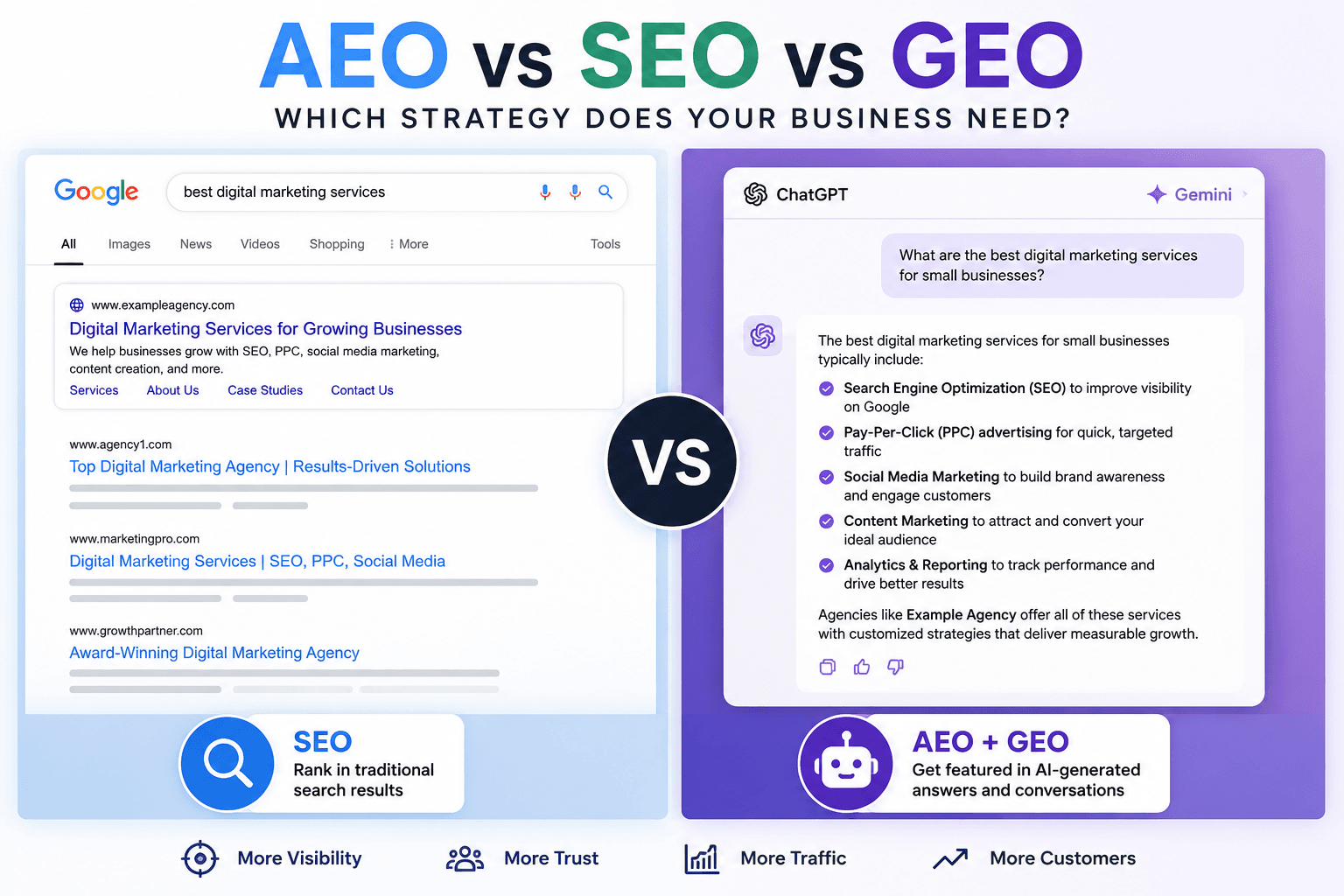
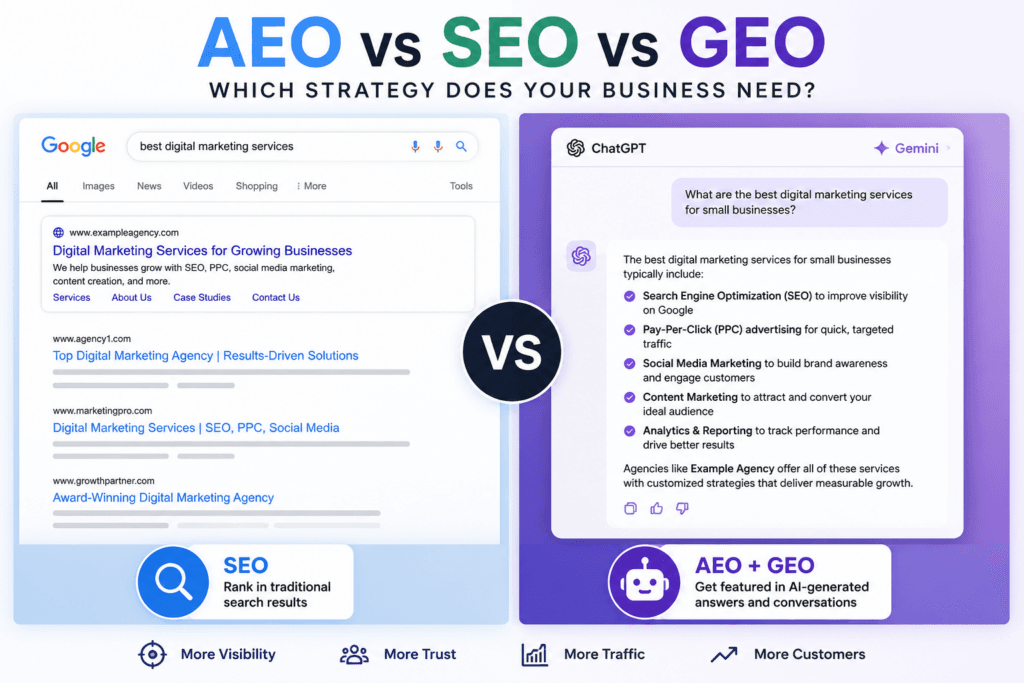
This shift is exactly why the debate around AEO vs SEO vs GEO has become so important for business owners. These three terms — Search Engine Optimization, Answer Engine Optimization, and Generative Engine Optimization — describe three different (but connected) ways people find businesses online today.
Here’s the short answer: most businesses do not need to choose only one. They need SEO as the foundation, AEO to win direct answers, and GEO to show up in AI-generated responses. Think of them as three layers of the same visibility strategy, not three competing options.
In this guide, you’ll learn what each term means, how they differ, and exactly how to optimize your website so it performs well on Google, ChatGPT, Gemini, and Google AI Overviews.
[Internal Link: AI Search Optimization Services]
2. What Is SEO?
Search Engine Optimization (SEO) is the practice of improving a website so it ranks higher in traditional search engine results, mainly on Google and Bing.
Quick definition: SEO is the process of optimizing a website’s content, structure, and authority so search engines can find it, understand it, and rank it for relevant search queries.
SEO works through several connected components:
- Keyword optimization – using the words and phrases your customers actually search for
- Technical SEO – making sure your site is fast, secure, and easy for search engines to crawl
- On-page SEO – optimizing titles, headings, content, and internal links on each page
- Off-page SEO – building your website’s reputation through backlinks and mentions
- Local SEO – optimizing your Google Business Profile and local listings for “near me” searches
- Content quality – publishing genuinely useful, well-researched content
- User experience – making your site easy to navigate on any device
- Search intent – matching content to what the searcher actually wants
Example: A local bakery optimizes its website for “custom birthday cakes in [city].” Over time, technical fixes, quality content, and local backlinks help the page rank on the first page of Google, bringing in steady organic traffic.
SEO remains the foundation of online visibility. Without it, search engines struggle to discover or trust your website — and that affects AEO and GEO too.
3. What Is AEO?
Answer Engine Optimization (AEO) is the practice of structuring content so it can be pulled out and shown as a direct answer — in featured snippets, People Also Ask boxes, voice search results, and chat-based assistants.
Quick definition: AEO is the process of formatting content, especially questions and answers, so search engines and voice assistants can extract it as a short, direct response to a user’s query.
AEO focuses on:
- Featured snippets – the highlighted answer box at the top of Google results
- People Also Ask results – expandable question boxes within search results
- Voice search answers – short, conversational responses read aloud by assistants
- FAQ sections – structured question-and-answer content
- Conversational queries – full-sentence, natural-language questions
- Question-based keywords – phrases like “how,” “what,” and “why”
- Structured data (schema markup) – code that helps engines understand your content
- Clear, short, direct answers – ideally within the first sentence or two
The key difference from traditional SEO is intent. SEO tries to rank a whole page. AEO tries to win a specific answer slot, often above or outside the standard results, by giving the clearest, most concise response to a specific question.
Featured-snippet-ready definition: AEO, or Answer Engine Optimization, is the practice of structuring website content — especially FAQs and headings — so it can be easily extracted as a direct answer by search engines and voice assistants.
4. What Is GEO?
Generative Engine Optimization (GEO) is the practice of improving how a brand or website appears within AI-generated answers produced by tools like ChatGPT, Gemini, Google AI Overviews, and Perplexity.
Quick definition: GEO is the process of building credibility, clarity, and citation-worthy content so generative AI tools are more likely to reference, mention, or recommend a business when answering user prompts.
GEO involves a different set of signals than classic ranking factors:
- Entity recognition – AI systems understanding who you are and what you do
- Brand mentions – your business being talked about across the web
- Trusted citations – appearing in sources AI models consider reliable
- Expert content – material written by credible, identifiable authors
- Original research and first-party data – information that can’t be found elsewhere
- Consistent brand information – your name, address, and details matching everywhere
- Strong digital presence – visibility across multiple reputable platforms
- Author credibility – bylines with real names and relevant experience
- Content clarity – information that is easy for AI models to parse and summarize
It’s important to be direct here: no business can guarantee a mention or recommendation from ChatGPT, Gemini, or any AI platform. These systems generate responses dynamically, and results vary by prompt, model version, and available sources. What you can do is improve your eligibility — making it more likely that AI systems find your content trustworthy, clear, and worth referencing.
Featured-snippet-ready definition: GEO, or Generative Engine Optimization, is the practice of improving a brand’s authority, clarity, and digital footprint so it is more likely to be cited or recommended within AI-generated search responses.
5. AEO vs SEO vs GEO: Key Differences
Understanding AEO vs SEO vs GEO becomes much easier once you compare them side by side. Each strategy targets a different part of the modern search journey, even though they share the same goal: getting your business in front of the right people.
| Factor | SEO | AEO | GEO |
|---|---|---|---|
| Primary goal | Rank pages in search results | Win direct answer placements | Get cited or mentioned in AI-generated responses |
| Main platforms | Google, Bing | Google featured snippets, voice assistants | ChatGPT, Gemini, Google AI Overviews, Perplexity |
| Content format | Full web pages, blogs, landing pages | FAQs, short definitions, structured lists | Authoritative, well-sourced, entity-rich content |
| Search behaviour | Typed keywords, browsing results | Questions, voice queries | Conversational prompts, follow-up questions |
| Ranking/visibility outcome | Position in search results | Snippet, PAA box, or voice answer | Mention or citation in an AI-generated summary |
| Key optimization methods | Keywords, backlinks, technical fixes | Schema, FAQs, concise answers | Authority, credibility, consistent entity data |
| Success metrics | Rankings, organic traffic | Snippet visibility, voice answer share | Brand mentions, AI citations, referral visits |
| Typical user journey | Search, click, browse | Search, read answer, may not click | Ask AI, get a summarized recommendation |
| Best use cases | Long-term organic growth | Quick informational queries | Recommendation and comparison queries |
In simple terms: SEO gets you found, AEO gets you quoted, and GEO gets you recommended. They aren’t separate strategies competing for your budget — they build on each other.
[Internal Link: Digital Marketing Services]
6. SEO vs AEO
SEO and AEO work toward different outcomes but rely on the same foundation.
SEO focuses on ranking entire pages for relevant keywords. AEO focuses on answering specific questions clearly enough that an engine can extract and display that answer directly. A page can rank well in SEO without ever winning a featured snippet. Likewise, a well-structured answer can appear in a snippet or voice search result even if the full page isn’t the top organic result.
AEO depends heavily on strong SEO fundamentals. If a page isn’t indexed, isn’t crawlable, or isn’t seen as trustworthy, it has little chance of being selected for a snippet — no matter how well the answer is written.
Practical example: A plumbing company’s page ranks fifth on Google for “how to fix a leaking tap.” But because the page includes a clear, 50-word answer near the top, Google pulls that exact text into a featured snippet — placing the business above the pages ranking higher than it.
7. SEO vs GEO
SEO and GEO both aim to build visibility, but they measure success differently.
SEO targets rankings within a search engine’s results page. GEO targets inclusion inside an AI-generated summary or recommendation, which may not involve a traditional results page at all. Traditional backlinks still matter for both, but in GEO, broader brand authority and consistent online mentions often carry more weight than any single link.
AI systems frequently pull information from multiple sources at once to generate a single answer. This means clear, consistent facts about your business — your services, location, pricing, and specialties — increase the likelihood that AI tools represent you accurately.
Practical example: An accounting firm invests in SEO and ranks well for “small business tax advisor.” Separately, because the firm is mentioned consistently across directories, review sites, and industry publications, Gemini includes it when a user asks for “trustworthy small business accountants” — a query the firm never specifically targeted with a landing page.
8. AEO vs GEO
AEO and GEO can look similar since both deal with AI-influenced results, but their focus is different.
AEO is about answer extraction — pulling a specific, well-formatted response to a specific question. GEO is about broader inclusion — being cited or mentioned as part of a generated response, often within a comparison, recommendation, or summary rather than a single direct answer.
Both require clear, structured, factual content. But AEO succeeds mainly through format (short answers, FAQs, schema), while GEO succeeds mainly through authority and trust signals (credibility, citations, consistent entity data).
Practical comparison: If someone asks “What are the symptoms of dehydration?” AEO helps a health website’s concise answer appear as a featured snippet. If someone asks ChatGPT “What’s a reliable urgent care clinic near me?” GEO factors — like the clinic’s reputation, reviews, and consistent listings — influence whether it gets mentioned at all.
9. Which One Does Your Business Need?
Most businesses benefit from all three strategies working together, but priority depends on business type.
- Local business: Prioritize SEO (especially local SEO) first, then GEO for trust-based recommendations, then AEO for FAQ-style local queries.
- Service-based company: Balance SEO and AEO to answer common service questions, with growing GEO investment for “best [service] near me” style AI prompts.
- E-commerce website: SEO remains essential for product and category pages; AEO helps with product FAQs; GEO matters increasingly for AI-assisted shopping comparisons.
- B2B business: GEO and SEO carry more weight, since buyers often research through AI tools before ever visiting a website.
- SaaS company: All three matter, but GEO is increasingly important as buyers ask AI tools to compare software options.
- Startup: Start with SEO to build a foundation, then layer in AEO and GEO as content and authority grow.
- Personal brand: GEO and AEO are highly valuable, since audiences often ask AI tools for expert recommendations by name or topic.
- Publisher or blog: AEO is critical for snippet and voice visibility; SEO drives sustained traffic; GEO builds long-term citation value.
- Healthcare or financial website: SEO and GEO both matter significantly, since these are trust-sensitive topics where AI systems prioritize authoritative, well-sourced information.
10. How to Optimize Your Website for ChatGPT and Gemini
- Publish accurate, genuinely helpful content — not content written only to target keywords.
- Build clear topic authority by covering your subject area thoroughly, not just superficially.
- Create detailed service and product pages with specific, factual descriptions.
- Add strong About Us and Contact pages that clearly explain who you are.
- Maintain consistent business information (name, address, phone number) across your website and third-party listings.
- Add author names and relevant credentials to your content.
- Reference trustworthy external sources to support your claims.
- Earn relevant backlinks and brand mentions from reputable websites.
- Create original research, statistics, case studies, or first-party data your competitors don’t have.
- Answer customer questions directly, without burying answers under long introductions.
- Update outdated content regularly, especially pricing, statistics, and policies.
- Strengthen brand visibility across reputable third-party websites and directories.
- Use clear headings and semantic HTML so content structure is easy to parse.
- Add relevant structured data (schema markup) where appropriate.
- Improve website crawlability and indexability so AI tools with browsing access can find your content.
- Avoid thin, copied, or purely AI-generated content with no original value.
It’s worth being transparent here: ChatGPT and Gemini recommendations can depend on the specific model, its browsing access, the sources available to it, user location, how a query is worded, and platform-specific features. None of these steps guarantee a recommendation, but together they meaningfully improve your chances of being considered a credible source.
11. How to Optimize for Google AI Overviews
- Match informational search intent precisely rather than writing generic content.
- Provide concise, direct answers near the beginning of each section.
- Cover the topic comprehensively, addressing related questions readers are likely to have.
- Support claims with credible evidence and sources.
- Include expert authorship with visible credentials.
- Add internal links to related, relevant pages on your site.
- Use descriptive, question-based headings where appropriate.
- Include FAQ content addressing common follow-up questions.
- Improve overall page experience, including speed and mobile usability.
- Use structured data where relevant to help Google understand your content.
- Keep important facts, prices, and statistics updated.
- Create unique value that goes beyond what competitors already publish.
Traditional SEO remains essential for AI Overviews because Google must first discover, understand, and trust a website before it can confidently use that site’s information in a generated summary. AI Overviews are built on top of Google’s existing index and ranking systems — they don’t replace them.
[SEO Services ]
12. Combined SEO, AEO and GEO Strategy
Here’s a simple three-step framework to bring all three strategies together.
Step 1: Build the SEO Foundation
- Conduct thorough keyword research
- Fix technical SEO issues (site speed, crawlability, mobile-friendliness)
- Match content to search intent
- Build strong internal linking
- Optimize page speed
- Ensure mobile optimization
- Earn quality backlinks
Step 2: Improve AEO Readiness
- Use question-based headings
- Add direct, concise definitions
- Build out FAQ sections
- Write short, extractable answers
- Use bullet lists for scannability
- Use comparison tables where relevant
- Implement schema markup
Step 3: Strengthen GEO Visibility
- Maintain entity consistency across the web
- Highlight author credibility
- Share original insights and data
- Build genuine brand mentions
- Earn trusted citations
- Keep facts clear and current
- Build topical authority over time
[Website Development Services]
13. Practical AEO, SEO and GEO Checklist
Use this checklist to audit your website right now.
- Is every important page indexed by Google?
- Does each page target a clear, specific search intent?
- Are customer questions answered directly, near the top of the page?
- Is your business information consistent across your website and directories?
- Does your website demonstrate real experience and expertise?
- Are your statistics and claims supported by credible sources?
- Does your content include visible author information?
- Are your key pages reviewed and updated regularly?
- Is structured data implemented correctly and matched to visible content?
- Does your brand have mentions on reputable third-party websites?
- Do your pages load quickly on mobile devices?
- Do you have a dedicated FAQ section on key pages?
- Are your headings descriptive and organized in a clear hierarchy?
- Do you have an About Us page with genuine, specific detail?
- Is your Google Business Profile complete and accurate (if applicable)?
- Do you avoid duplicate or thin content across your site?
- Are your internal links relevant and helpful to readers?
- Do you publish original insights, not just summarized information?
- Is your contact information easy to find and verify?
- Have you reviewed your content for outdated facts or figures?
14. Common Mistakes to Avoid
- Treating GEO as a replacement for SEO instead of an extension of it
- Publishing generic, AI-generated content with no original insight
- Keyword stuffing instead of writing naturally
- Making unsupported claims or promises
- Creating too many low-quality, thin pages
- Ignoring technical SEO fundamentals
- Using outdated statistics or pricing
- Hiding important answers under long, unnecessary introductions
- Ignoring brand reputation and third-party reviews
- Allowing inconsistent business information across platforms
- Expecting guaranteed ChatGPT or Gemini recommendations
- Adding schema markup that doesn’t match what’s visible on the page
15. How to Measure SEO, AEO and GEO Performance
SEO Metrics
- Organic traffic
- Keyword rankings
- Search impressions
- Click-through rate
- Conversions
- Backlink growth
AEO Metrics
- Featured snippet visibility
- People Also Ask visibility
- Question-keyword rankings
- Voice-search-friendly query performance
- FAQ page engagement
GEO Metrics
- Referral traffic from AI tools, where trackable
- Brand mentions in AI-generated responses
- Citations across AI search platforms
- Growth in branded search volume
- Third-party brand mentions
- Assisted conversions
- Visibility for recommendation-based prompts
It’s worth noting that GEO measurement is still developing. Unlike SEO, where analytics tools provide clear ranking and traffic data, AI citation tracking is less mature, and results may not always be fully visible in traditional analytics platforms.
16. Final Verdict
So, AEO vs SEO vs GEO — which one wins? None of them, individually.
SEO is the foundation that helps search engines discover, understand, and trust your website. AEO helps your business become the direct answer to specific customer questions. GEO helps your business become a trusted source that generative AI tools are willing to cite or recommend.
A combined strategy — strong SEO, structured AEO-ready content, and consistent GEO-friendly authority signals — gives your business the strongest long-term visibility across both traditional and AI-powered search.
Practical next step: Start with the checklist in Section 13. Audit your website this week, fix the gaps you find, and revisit your content quarterly as search behaviour keeps evolving.
17. Frequently Asked Questions
1. What is the difference between SEO, AEO and GEO? SEO focuses on ranking web pages in traditional search results. AEO focuses on winning direct answer placements like featured snippets and voice results. GEO focuses on getting cited or recommended within AI-generated responses from tools like ChatGPT and Gemini.
2. Is AEO replacing SEO? No. AEO builds on top of SEO rather than replacing it. Strong technical SEO and quality content are still required before a page has any chance of winning a featured snippet or voice search answer.
3. Is GEO the same as AI SEO? GEO is often called “AI SEO” informally, but it’s a distinct discipline. It focuses on brand authority, entity recognition, and citation-worthiness within generative AI tools, rather than traditional page rankings.
4. How can I optimize my website for ChatGPT? Publish accurate, well-structured content with clear author credibility, consistent business information, and supporting sources. There’s no guaranteed method, but these steps improve your eligibility to be referenced.
5. How can my business get recommended by Gemini? Build a strong, consistent digital presence with accurate information across your website and third-party platforms. Genuine expertise, reviews, and mentions from credible sources all contribute to being considered trustworthy.
6. Can SEO help my website appear in Google AI Overviews? Yes. Google AI Overviews are built on top of Google’s existing search index, so strong SEO fundamentals — crawlability, relevance, and trust — remain essential for AI Overview visibility.
7. Does schema markup help with AEO and GEO? Yes, schema markup helps search engines and AI tools understand your content structure more clearly, which can support both featured snippet eligibility and accurate AI-generated summaries.
8. Do backlinks matter for generative engine optimization? Yes, though their role shifts slightly. In GEO, backlinks contribute to overall brand authority and mentions across the web, which AI systems may factor into how trustworthy a source appears.
9. Can AI platforms guarantee business recommendations? No platform can guarantee a recommendation or citation. AI-generated responses vary based on the model, available sources, query wording, and other factors outside a business’s direct control.
10. Should small businesses invest in GEO? Yes, especially as more customers use AI tools for recommendations. However, small businesses should build a solid SEO foundation first, since GEO relies on the same trust and authority signals that SEO helps establish.