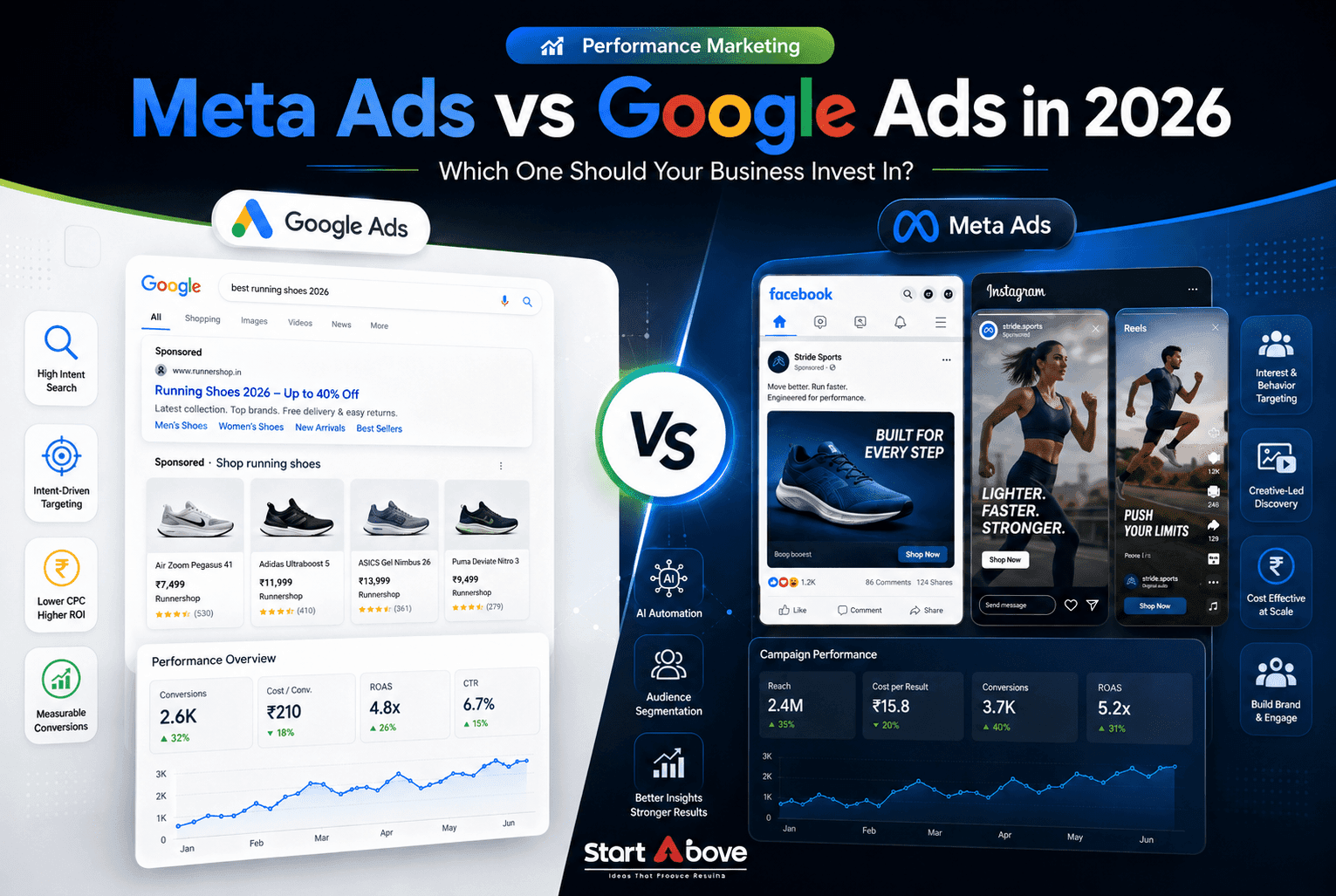
Every business owner running paid advertising eventually faces the same question: should I be spending on Meta Ads (Facebook and Instagram) or Google Ads? Both platforms are powerful. Both can generate real results. But they work in very different ways — and putting your budget in the wrong place can be an expensive mistake.
In 2026, the advertising landscape has evolved significantly. AI-powered bidding, smarter audience targeting, new ad formats, and shifting user behaviours mean the decision is no longer as simple as picking one over the other.
This guide breaks down everything you need to know — costs, targeting, audience intent, ad formats, and which platform works best for different types of businesses — so you can make the right call for your brand.
How Each Platform Works
Google Ads: Capture Demand That Already Exists
Google Ads operates on a search-intent model. When someone types “best digital marketing agency in Pune” into Google, they are actively looking for a solution. Your ad appears at that exact moment of intent.
This is what marketers call demand capture — you are reaching people who are already in buying mode. Google Ads also covers YouTube, Display, Shopping, and Gmail placements, making it a broad ecosystem beyond just search.
Meta Ads: Create Demand Through Discovery
Meta Ads (Facebook and Instagram) work on a social discovery model. Users are not searching for your product. They are scrolling through their feed, watching Reels, or browsing Stories — and your ad appears in between.
This is demand creation. You are introducing your brand to people who may not have been looking but are the right audience for what you offer. Meta’s strength is its rich demographic and interest-based targeting built from billions of user data points.
Meta Ads vs Google Ads: Side-by-Side Comparison
| Feature | Google Ads | Meta Ads |
| Intent | High (active search) | Low to medium (passive browsing) |
| Ad format | Text, Shopping, Display, Video | Image, Video, Carousel, Stories, Reels |
| Targeting basis | Keywords, device, location | Demographics, interests, behaviours, lookalikes |
| Average CPC (India, 2026) | ₹20–₹150 (varies by industry) | ₹5–₹50 (varies by audience) |
| Best for | High-intent purchases, local services | Brand awareness, impulse buys, B2C products |
| Conversion speed | Faster (buyer already searching) | Slower (needs nurturing) |
| Audience size | Limited to search volume | Massive — entire Facebook/Instagram user base |
| Visual appeal required | Low (text ads work well) | High (creative is critical) |
| Retargeting | Strong (Google Display) | Extremely strong (custom audiences) |
| AI/Automation (2026) | Performance Max, Smart Bidding | Advantage+, AI-generated creatives |
Cost Comparison: Which Platform Is More Affordable?
Cost is one of the most frequently asked questions when comparing these two platforms. The honest answer: it depends on your industry, targeting, and creative quality.
Google Ads Costs in 2026
Google Ads are priced on a Cost Per Click (CPC) model. Because you are bidding against competitors for the same high-intent keywords, costs can be higher — especially in competitive industries.
- Legal services: ₹150–₹400 per click
- Real estate: ₹80–₹200 per click
- E-commerce (retail): ₹20–₹60 per click
- Local services (restaurants, salons): ₹15–₹40 per click
However, the conversion rates are typically higher because users already have purchase intent.
Meta Ads Costs in 2026
Meta Ads tend to have lower CPCs on average, but require more investment in creative production (graphics, videos, copywriting) to perform well.
- Average CPC on Instagram: ₹8–₹35
- Average CPC on Facebook: ₹5–₹25
- Cost Per 1000 Impressions (CPM): ₹40–₹120
While the entry cost is lower, poor creatives will waste your budget quickly. Great visuals and compelling copy are non-negotiable on Meta.
| 💡 Start Above Insight The lowest-cost platform is not always the most profitable. A ₹100 click on Google that converts at 8% beats a ₹20 click on Meta that converts at 1%. Always evaluate Cost Per Acquisition (CPA), not just Cost Per Click. |
Targeting Capabilities: Who Can You Reach?
Google Ads Targeting
- Keyword targeting — appear for exact search terms
- Location targeting — city, pin code, or radius
- Device targeting — mobile, desktop, tablet
- Remarketing — show ads to past website visitors
- Customer Match — upload email lists and target them on Google
- In-market audiences — people actively researching your category
Google’s AI-powered Performance Max campaigns now automatically run across all Google channels (Search, Display, YouTube, Gmail, Maps) using a single campaign — a major evolution in 2026.
Meta Ads Targeting
- Demographic targeting – age, gender, location, language
- Interest targeting – hobbies, pages liked, topics followed
- Behavioural targeting – purchase behaviour, device usage, travel habits
- Lookalike audiences — reach new users similar to your best customers
- Custom audiences — retarget website visitors, app users, or video viewers
- Engagement retargeting — people who interacted with your Instagram or Facebook
Meta’s Advantage+ campaigns in 2026 use AI to automatically find the best audiences for your ads — reducing the need for manual audience setup while improving results.
Ad Formats: What Can You Create?
Google Ads Formats
- Search ads — text ads appearing in Google search results
- Display ads — banner and image ads across 2 million+ websites
- Shopping ads — product listings with image, price and name
- YouTube ads — pre-roll, mid-roll, and bumper video ads
- Performance Max — AI-driven multi-format campaigns
- Local service ads — for service businesses (plumbers, lawyers, agencies)
Meta Ads Formats
- Image ads — single image with headline and CTA
- Video ads — up to 60 minutes, typically 15–30 seconds perform best
- Carousel ads — multiple images or videos in one ad, each with its own link
- Collection ads — mobile-first format for e-commerce product discovery
- Reels ads — full-screen vertical video ads in Instagram and Facebook Reels
- Stories ads — full-screen vertical ads between stories
- Lead gen ads — built-in forms to collect leads without leaving the platform
| 📌 Trend Alert (2026) Short-form vertical video (Reels ads on Meta and YouTube Shorts ads on Google) is now the highest-performing format for awareness and impulse-buy campaigns across both platforms. |
Which Platform Works Best for Your Business Type?
| Business Type | Google Ads | Meta Ads |
| E-commerce (product sales) | ✓ Strong | ✓✓ Best (visual, impulse) |
| Local services (salons, gyms, plumbers) | ✓✓ Best (local intent) | ✓ Good for awareness |
| B2B lead generation | ✓✓ Best (search intent) | ✓ Good (LinkedIn often better) |
| Real estate | ✓✓ Best (high-intent search) | ✓ Good for branding |
| Restaurants & food delivery | ✓ Good (local search) | ✓✓ Best (visual & impulse) |
| App installs | ✓ Good (UAC campaigns) | ✓✓ Best (App campaigns) |
| Brand awareness (new brand) | ✓ Good (Display/YouTube) | ✓✓ Best (reach & frequency) |
| Event promotion | ✓ Good | ✓✓ Best (social sharing) |
| Education / Coaching | ✓✓ Best (search intent) | ✓ Good for retargeting |
| Fashion & Lifestyle | ✓ Good | ✓✓ Best (Instagram visual) |
How AI Is Changing Both Platforms in 2026
Both platforms have invested heavily in AI-powered automation. Understanding how this affects your campaigns is critical in 2026.
Google’s AI Updates
- Performance Max now generates ad creatives automatically using AI
- Smart Bidding uses real-time signals to optimise for conversions or revenue
- Google AI Overviews (in search) now show ads integrated with AI answers
- Demand Gen campaigns target users across YouTube, Gmail, and Discover
The implication: you need fewer campaigns to cover more ground, but your asset quality (images, headlines, descriptions) matters more than ever because AI picks the best combinations.
Meta’s AI Updates
- Advantage+ Shopping and Advantage+ Audience remove the need to manually define audiences
- AI-generated ad variations test multiple creative combinations automatically
- Meta AI now suggests copy, headlines, and even image variations inside Ads Manager
- Automated placements across Facebook, Instagram, and Messenger are now the default
The implication: manual audience targeting is becoming less important. What matters is giving Meta high-quality inputs — good creatives, strong offers, and clear conversion signals.
The Smart Approach: Use Both Together
The most effective businesses in 2026 do not treat Meta Ads and Google Ads as competitors. They use them together as a full-funnel strategy.
| Full-Funnel Strategy: Awareness (Meta Reels/Display) → Consideration (Meta Retargeting + Google Display) → Decision (Google Search) → Loyalty (Meta Custom Audiences) |
Recommended Budget Split by Business Stage
| Business Stage | Google Ads % | Meta Ads % |
| New brand / awareness phase | 30% | 70% |
| Established brand seeking leads | 60% | 40% |
| E-commerce with product catalogue | 40% | 60% |
| Local service business | 70% | 30% |
| B2B company | 65% | 35% |
Frequently Asked Questions
Which platform has better ROI-Meta or Google?
ROI depends entirely on your industry and goal. Google Ads typically delivers faster ROI for high-intent services and B2B. Meta Ads delivers better ROI for brand building, e-commerce, and impulse purchases.
What is the minimum budget to start on each platform?
You can start on Google Ads with as little as ₹500/day, though ₹1,500–₹2,000/day is recommended for meaningful data. Meta Ads can start at ₹300/day per ad set, but ₹800–₹1,200/day gives the algorithm enough room to optimise.
Do I need a website to run ads on both platforms?
Google Ads requires a landing page or website. Meta Ads offers Lead Gen ads that collect information without needing a website, making it more accessible for new businesses.
Which platform is better for small businesses in India?
For local service businesses (salons, gyms, clinics, restaurants) in Indian cities like Pune, Google Ads with location targeting often delivers better ROI because users actively search with local intent. Meta is better for building awareness and reaching a wider audience affordably.
Can I run both Google Ads and Meta Ads at the same time?
Yes, and this is the recommended approach for most growing businesses. Running both creates a full-funnel strategy where Meta builds awareness and Google captures the resulting search intent.
Final Verdict
Neither platform is universally better. The right choice depends on your business type, goals, industry, and budget stage.
- Choose Google Ads if you have a service-based or B2B business, need fast lead generation, or are targeting people with clear purchase intent.
- Choose Meta Ads if you sell visual products, want to build brand awareness, run an e-commerce store, or need to reach a broad audience affordably.
- Combine both if you want to build a sustainable, full-funnel paid marketing engine that drives awareness and conversions together.
The most important step is not choosing the right platform — it is tracking your results, understanding your Cost Per Acquisition, and continuously optimising. Both platforms reward advertisers who test, measure, and improve.