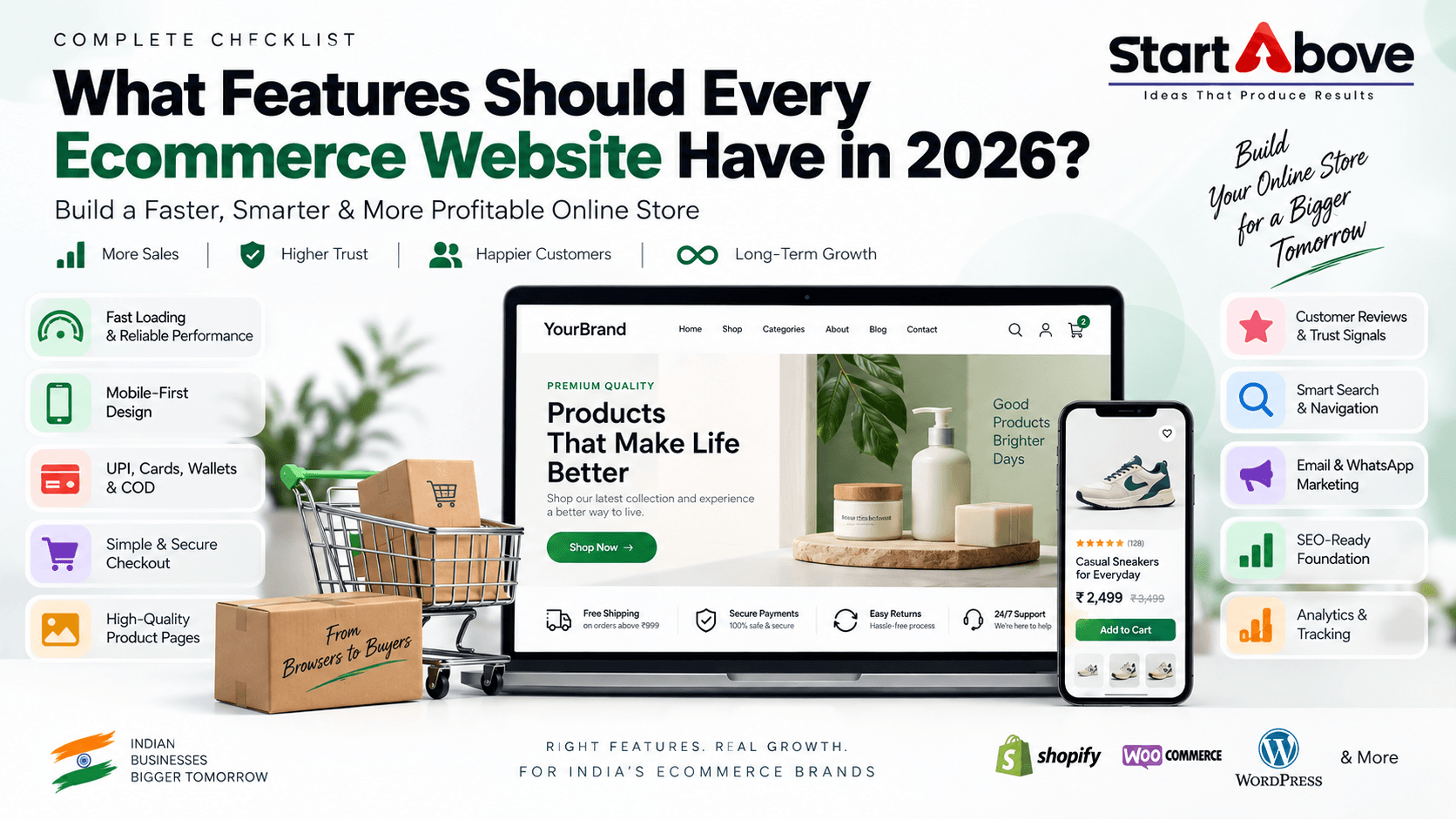

A successful ecommerce website in 2026 needs more than an attractive design.
The most important ecommerce website features are the ones that help customers discover products quickly, trust your business, complete payments smoothly and return for future purchases.
For Indian ecommerce businesses, this usually means combining mobile-first design, fast loading, UPI and COD support, strong product pages, simple checkout, clear policies, SEO, analytics and retention tools.
Whether you are launching a new Shopify or WooCommerce store or improving an existing ecommerce website, this checklist covers the features that matter most.
What Are the Most Important Ecommerce Website Features in 2026?
Every modern ecommerce website should ideally include:
- Fast loading performance
- Mobile-first responsive design
- UPI, cards and other relevant payment methods
- Cash on Delivery where appropriate
- Simple checkout
- Clear product categories
- Smart search and filters
- High-quality product images and videos
- Detailed product descriptions
- Genuine customer reviews
- Visible shipping and return policies
- Secure checkout
- WhatsApp or customer-support options
- Abandoned-cart recovery
- Upselling and cross-selling
- SEO-friendly product and category pages
- Structured data
- Analytics and conversion tracking
The exact setup depends on your products, customers and business model, but these provide a strong foundation.
1. Fast Website Loading and Reliable Performance
Website speed should be treated as a core ecommerce feature rather than a technical extra.
Customers should be able to open your homepage, browse collections and view product pages without unnecessary waiting.
A slow store can create friction before the buying journey even begins.
What Can Make an Ecommerce Website Slow?
Common causes include:
- Large unoptimized images
- Too many apps or plugins
- Heavy themes
- Excessive scripts
- Poor hosting
- Unoptimized product videos
- Old page builders
- Third-party tracking scripts
- Large product catalogues without proper optimization
A good ecommerce development process should focus on performance from the beginning.
Why Is Mobile Speed Important?
Many ecommerce customers browse from smartphones, so mobile loading performance is particularly important.
Your store should be tested on real mobile devices, not only desktop screens.
2. Mobile-First Responsive Design
A website that simply shrinks to fit a mobile screen is not necessarily mobile optimized.
A proper mobile-first ecommerce website should be easy to browse, search and purchase from using one hand.
Important mobile UX features include:
- Large tap-friendly buttons
- Easy navigation
- Readable text
- Fast-loading images
- Simple product galleries
- Sticky Add to Cart where appropriate
- Easy checkout forms
- Mobile-friendly filters
- Clear WhatsApp or contact buttons
The goal is to reduce friction throughout the buying journey.
3. Multiple Payment Options for Indian Customers
Payment flexibility is an important ecommerce feature for Indian businesses.
Depending on your audience and payment gateway, your store may support:
- UPI
- Debit cards
- Credit cards
- Net banking
- Wallets
- Cash on Delivery
- EMI or pay-later options where appropriate
Customers should be able to choose a payment method they already trust.
Should an Ecommerce Website Offer COD?
COD can be useful for certain audiences and product categories.
However, businesses should also consider:
- COD verification
- Shipping costs
- RTO risk
- Order confirmation
- PIN-code restrictions
- Customer history
COD should therefore be implemented as part of a broader logistics strategy.
4. Simple and Fast Checkout
One of the most important ecommerce conversion features is a smooth checkout experience.
Customers should not need to complete unnecessary steps before placing an order.
A good checkout should minimize:
- Form fields
- Page transitions
- Distractions
- Mandatory registration
- Confusing delivery options
- Unexpected charges
Where your platform supports it, guest checkout can help reduce unnecessary friction.
The checkout should clearly show:
Product → Price → Shipping → Payment → Order Confirmation
5. High-Quality Product Pages
Product pages often play the role of salesperson in an ecommerce store.
A strong product page should answer most of the customer’s important questions without requiring them to contact your team.
What Should an Ecommerce Product Page Include?
Consider including:
- Product name
- Clear product images
- Multiple product angles
- Product videos
- Price
- Variants
- Availability
- Product benefits
- Specifications
- Size information
- Ingredients or materials
- Usage instructions
- Delivery information
- Return information
- FAQs
- Customer reviews
- Related products
- Add to Cart or Buy Now CTA
For SEO, each important product page should also have unique written content.
6. High-Quality Images and Product Videos
Customers cannot physically inspect products online.
Your images and videos therefore need to communicate:
- Product quality
- Size
- Colour
- Texture
- Packaging
- Usage
- Variants
- Important details
Product photography should be clear, consistent and optimized for fast loading.
Short product videos can be particularly useful for fashion, food, beauty, lifestyle, machinery and demonstration-based products.
7. Clear and Helpful Product Descriptions
Product descriptions should not simply repeat what is already visible in the product title.
Good descriptions answer questions such as:
- What is the product?
- Who is it for?
- What problem does it solve?
- What are its key benefits?
- What is included?
- How should it be used?
- What size or quantity is included?
- Are there any important care instructions?
Clear descriptions can improve customer confidence and reduce unnecessary support queries.
8. Genuine Customer Reviews
Reviews can help first-time visitors evaluate the experiences of previous customers.
Useful ecommerce review features can include:
- Star ratings
- Written reviews
- Customer photos
- Verified purchase indicators
- Product-specific reviews
Avoid fabricated testimonials.
Authentic reviews provide far more long-term value for customer trust.
9. Clear Trust Signals
A customer visiting your website for the first time may not know your business.
Your website therefore needs to answer an important question:
“Can I trust this store enough to place an order?”
Useful trust elements include:
- Real company information
- Phone number
- Business email
- WhatsApp support
- Physical address where applicable
- Shipping policy
- Return or replacement policy
- Privacy policy
- Terms and conditions
- Secure payment processing
- Customer reviews
- Social-media profiles
Do not hide important information deep inside the website.
10. Smart Search, Filters and Navigation
As your product catalogue grows, navigation becomes increasingly important.
Customers should be able to move quickly from:
Homepage → Category → Product
without searching through dozens of irrelevant products.
Ecommerce Search Features
A useful search system may support:
- Product names
- Categories
- Common spelling variations
- SKUs
- Relevant keywords
Ecommerce Filters
Depending on your product type, filters can include:
- Price
- Size
- Colour
- Brand
- Category
- Material
- Availability
- Product type
- Rating
Good search and filters become especially important for stores with large catalogues.
11. Email and WhatsApp Integration
An ecommerce website should not depend entirely on paid advertising for every future purchase.
Email and WhatsApp can help businesses maintain a direct relationship with customers.
They can be used for:
- Order confirmation
- Shipping updates
- Product launches
- Back-in-stock alerts
- Reorder reminders
- Promotional campaigns
- Abandoned-cart messages
- Customer-support communication
Marketing communication should follow relevant consent and privacy requirements.
12. Abandoned Cart Recovery
Not every customer who adds a product to their cart completes the purchase.
An abandoned-cart recovery system can help reconnect with customers who leave before checkout.
Depending on your platform and marketing setup, reminders may be sent through:
- SMS
- Retargeting ads
These messages should be useful and appropriately timed rather than excessive.
13. Upselling and Cross-Selling Features
You do not always need more traffic to increase ecommerce revenue.
Sometimes existing customers can be shown relevant additional products.
Examples include:
Frequently Bought Together
Customers Also Bought
Complete the Look
Add This for ₹X More
Upgrade to a Larger Pack
These features can help increase average order value when recommendations are relevant.
14. SEO-Friendly Ecommerce Structure
A well-designed ecommerce website should be built so search engines can easily understand products, categories and website structure.
Important ecommerce SEO features include:
- SEO-friendly URLs
- Unique product titles
- Optimized meta titles
- Meta descriptions
- Product descriptions
- Category-page content
- Image alt text
- Internal linking
- Breadcrumb navigation
- XML sitemap
- Canonical tags
- Product schema
- Breadcrumb schema
- Organization schema
- Clean website architecture
SEO should be planned during development rather than added after the website is complete.
15. Optimized Product and Category Pages
Both product pages and category pages can attract search traffic.
For example, instead of relying entirely on a URL such as:
website.com/product?id=483829
a cleaner structure could be:
website.com/collections/mens-shirts
or:
website.com/products/cotton-formal-shirt
The exact URL structure depends on your ecommerce platform.
Category pages should also have helpful content rather than functioning only as product grids.
16. Structured Data and Schema Markup
Schema markup helps search engines interpret website information in a structured format.
Relevant ecommerce schema can include:
- Product
- Offer
- Breadcrumb
- Organization
- FAQ where appropriate
- Review when eligible
Proper schema implementation can make your website easier for search systems to understand.
It should reflect genuine page content rather than information added only for search engines.
17. Analytics and Conversion Tracking
You cannot improve an ecommerce website effectively if you do not know what customers are doing.
Depending on your marketing setup, useful measurement tools can include:
- Google Analytics 4
- Google Search Console
- Google Merchant Center
- Meta Pixel
- Google Ads conversion tracking
- Heatmaps
- Ecommerce event tracking
Important events to measure can include:
- Product views
- Add to cart
- Begin checkout
- Purchase
- Form submission
- WhatsApp clicks
This data helps identify where customers are dropping out of the buying journey.
18. Inventory and Stock Management
A modern ecommerce website should clearly display product availability.
Useful features can include:
- In-stock status
- Out-of-stock status
- Low-stock alerts
- Back-in-stock notifications
- SKU management
- Variant inventory
- Automatic stock updates
Accurate inventory information helps avoid cancelled orders and customer frustration.
19. Order Tracking
Customers should be able to understand what happens after they place an order.
An effective order-tracking experience can provide:
- Order confirmation
- Shipping confirmation
- Tracking number
- Courier details
- Delivery status
- Estimated timeline
Tracking can also be connected to email, SMS or WhatsApp depending on your setup.
20. Clear Shipping, Return and Refund Information
Customers should not need to search extensively for basic policy information.
Important policies should clearly explain:
- Shipping charges
- Free-shipping conditions
- Delivery timelines
- COD availability
- Cancellation rules
- Return eligibility
- Replacement process
- Refund timelines
Transparency before purchase can reduce misunderstandings after purchase.
Ecommerce Website Features Checklist for 2026
| Category | Must-Have Features |
|---|---|
| Performance | Fast loading, optimized images, reliable hosting |
| Mobile UX | Responsive layout, tap-friendly navigation, easy checkout |
| Payments | UPI, cards, net banking, wallets, COD where relevant |
| Checkout | Simple flow, minimal fields, clear charges |
| Product Pages | Images, descriptions, specifications, reviews |
| Trust | Policies, contact details, secure checkout |
| Navigation | Categories, search and filters |
| Retention | Email, WhatsApp, abandoned-cart recovery |
| Conversion | Upsells, cross-sells, strong CTAs |
| SEO | Metadata, schema, clean URLs, internal linking |
| Analytics | GA4, Search Console, conversion tracking |
| Operations | Inventory management, shipping and tracking |
Which Ecommerce Features Should You Prioritize First?
If you are launching a new ecommerce store, prioritize the features that directly affect whether customers can discover, trust and purchase from you.
Start with:
- Fast mobile performance
- Clear navigation
- Strong product pages
- Reliable payments
- Simple checkout
- Shipping setup
- Clear policies
- Basic SEO
- Analytics
- Customer support
Retention tools, automation and advanced personalization can then be added as your store grows.
Shopify vs WooCommerce: Can Both Support These Features?
Yes.
Both Shopify and WooCommerce can support most of the ecommerce features discussed above.
The better platform depends on factors such as:
- Business size
- Product catalogue
- Budget
- Customization needs
- Technical management
- Integrations
- Marketing requirements
- Long-term growth plans
Shopify is often chosen for its managed ecommerce ecosystem, while WooCommerce can offer greater flexibility within WordPress.
The correct choice depends on your business rather than one platform being universally better.
Frequently Asked Questions About Ecommerce Website Features
What features should every ecommerce website have?
Every ecommerce website should have fast loading, mobile responsiveness, easy navigation, secure payments, clear product pages, simple checkout, customer reviews, transparent policies, analytics and an SEO-friendly structure.
Indian ecommerce stores should also consider UPI, COD, WhatsApp integration and appropriate logistics integrations.
What are the most important ecommerce website features for Indian customers?
Important features for Indian ecommerce customers can include UPI payments, cards, COD where appropriate, mobile-friendly checkout, WhatsApp support, transparent shipping charges and reliable order tracking.
The right combination depends on your customer profile.
Do I need all ecommerce features from day one?
No.
You should launch with the features required to provide a reliable buying experience.
Advanced automation, loyalty programs, subscriptions and personalization can be introduced gradually as the business grows.
Which ecommerce feature is most important for conversions?
There is no single feature that guarantees higher conversions.
However, product clarity, fast mobile performance, trust, payment flexibility and a simple checkout are among the most important areas because they directly influence the customer’s buying journey.
Is mobile optimization important for ecommerce?
Yes.
Customers increasingly expect to browse products, make payments and track orders from smartphones.
Your ecommerce experience should therefore be designed and tested for mobile users from the beginning.
Can I add these ecommerce features to my existing website?
In many cases, yes.
Features such as payment methods, reviews, analytics, WhatsApp, abandoned-cart recovery and SEO improvements can often be added to an existing Shopify or WooCommerce website.
If the underlying website is outdated or structurally limited, a redesign may be more practical.
What is the best ecommerce platform for a small business in India?
The right ecommerce platform depends on budget, catalogue size, customization, integrations and management preferences.
Shopify and WooCommerce are both common options for Indian businesses.
A proper requirement analysis should be done before choosing a platform.
How much does ecommerce website development cost in India?
The cost varies based on:
- Platform
- Number of products
- Custom design
- Payment integrations
- Shipping integrations
- Apps or plugins
- Custom functionality
- SEO
- Marketing integrations
A basic ecommerce setup and a heavily customized ecommerce store can therefore have very different development costs.
Looking for Ecommerce Website Development in Pune or India?
An ecommerce website should do more than display products.
It should help customers discover products, trust your business, complete purchases and return for future orders.
What are the essential features of an ecommerce website in 2026?
An ecommerce website in 2026 should include fast loading, mobile-first design, secure payments, simple checkout, strong product pages, customer reviews, search and filters, clear policies, SEO, analytics, order tracking and retention tools such as email or WhatsApp.
Which payment methods should an ecommerce website in India support?
Indian ecommerce stores should usually support UPI, credit cards, debit cards, net banking and relevant wallets. COD can also be useful depending on the customer base, product category and logistics strategy.
Does every ecommerce website need Cash on Delivery?
No. COD can help some businesses improve conversion, but it can also increase RTO risk and logistics costs. It should be offered only when it makes sense for your audience and fulfilment process.
What makes an ecommerce website mobile-friendly?
A mobile-friendly ecommerce website should have fast loading, readable text, tap-friendly buttons, easy navigation, responsive product images, simple filters and a checkout flow designed for smaller screens.
Why is website speed important for ecommerce?
Speed affects user experience, product discovery and checkout completion. A slow site can cause visitors to leave before they browse products or complete a purchase.
We can help with:
- Shopify website development
- WooCommerce website development
- Ecommerce website redesign
- Product catalogue setup
- Payment gateway integration
- UPI and COD setup
- Shipping integration
- WhatsApp integration
- Product-page optimization
- Ecommerce SEO
- Google Analytics and tracking
- Conversion optimization
- Performance marketing
If you already have an ecommerce website, we can also review it to identify missing features, usability problems, SEO opportunities and conversion issues.
Build an Ecommerce Website Designed to Sell
Whether you are launching your first online store or improving an existing ecommerce business, the right combination of design, technology, payments, SEO and customer experience can create a much stronger foundation for growth.
Start Above LLP
📞 +91 88882 73239 | +91 9028317379
✉️ info@startabove.in
📍 484/21, Bhaginikrupa, Mitra Mandal Housing Society, Parvati, Pune, Maharashtra 411009
Get in touch with Start Above LLP for ecommerce website development and consultation.